
[ad_1]
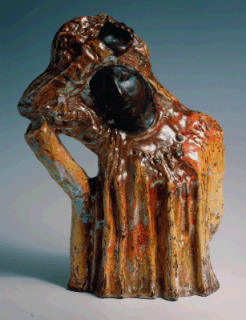
Volgova (glaçure bleue et jaune), 1898
Moscou, Galerie Trétiakov
© Galerie Trétiakov
Abramtsevo and Talashkino
The return to origins was particularly marked in the artistic centres and colonies which focused on the production of decorative art objects – furniture, boxes, small implements etc; – by kustari (peasant craftsmen) after models designed by city-dwelling artists.
The two main centres were Abramtsevo, near Moscow, under the patronage of S.I.
Mamontov which began as early as the 1880s, and Talashkino, established after 1900 near Smolensk under the initiative of Princess Maria K. Tenisheva. Wares from Talashkino are well represented in this exhibition thanks to exceptional loans from the Smolensk Museum-and-State-Reserve.
In her autobiography, Maria Tenisheva explains how she wanted “use simple materials everyone could afford to achieve objects which were elegantly realised, a pleasure to use, original and harmonious in form, by putting to decorative use things as simple as canvas, needlework, stones and metals”.
During the same period, a third centre, less innovative and more commercial, was set up in the city of Sergiev Posad which was known for its ancient wood sculpture tradition. These studios continued in commercialised production until the 1910s-1920s.
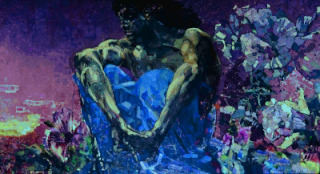
Le démon assis, 1890
Moscou, Galerie Trétiakov
© Galerie Trétiakov
Mikhail A. Vrubel (1856-1910)
The painter Mikhail Vrubel who had studied at the Saint-Petersburg Academy of Fine-Arts, joined the Abramtsevo colony in 1889.
Vrubel stands out as a profoundly original artist who was to bring Russian art to the brink of the 20th century.
In Abramtsevo, whilst continuing to paint – in particular an exceptional series of “demons”- Vrubel also worked in fields as diverse as ceramics, architecture, sculpture, decorative panelling, and theatre sets. He became the most outstanding representative of the Russian Art Nouveau known as the “Modern Style”.
Despite the singularity of his work, Vrubel’s wide range of activities, combined with his interest in traditional sources, place him unquestionably in the flow of the Russian zeitgeist.
An entire section of the exhibition is given over to Vrubel which, even though he is more frequently associated with European symbolism, sets his work within the context of the evolution of a Russian national art.
In the final decade of his life, Vrubel suffered from a mental condition that necessitated increasingly frequent periods of hospitalisation. From 1902 until he stopped working in 1906, he devoted his time to drawing. He may be said to have single-handedly provided the transition between two generations of artists.
[ad_2]
Source link

No Comment! Be the first one.