
[ad_1]
At the opening of Thomas Houseago. Sculptures. Banca March Garden in Madrid, the artist Thomas Houseago spoke bluntly about the distance he perceives between contemporary art and public life. The art world, he said, risks becoming ‘its own island,’ where art circulates within a closed circuit of insiders rather than reaching outward.
Against this isolation, he offers a counterpoint: art should be as reachable as music or film.
He is now testing this conviction in the Barrio de Salamanca, though this is not quite an argument for radical accessibility – the Barrio de Salamanca is one of Madrid’s most affluent districts. Behind the wide stone boulevards and 19th century facades of Calle de Castelló, a garden lies concealed, invisible from the street until one is already inside.
This green oasis, spanning more than 1600 square metres, is a place of unusual calm where chestnut and pine trees sway in the breeze. Now, beside a reflective pond that catches fragments of sky, it’s also home to Houseago’s nearly five-metre-tall bronze sculpture Large Walking Figure I (Leeds).
Thomas Houseago in Madrid – quick links
A secret garden in Madrid
Once the private garden of the March family home and now the headquarters of Banca March, the garden is rarely open to the public, however, to mark its centenary, the institution has reopened the grounds for this presentation of Houseago’s work, the artist’s first major exhibition in Spain.
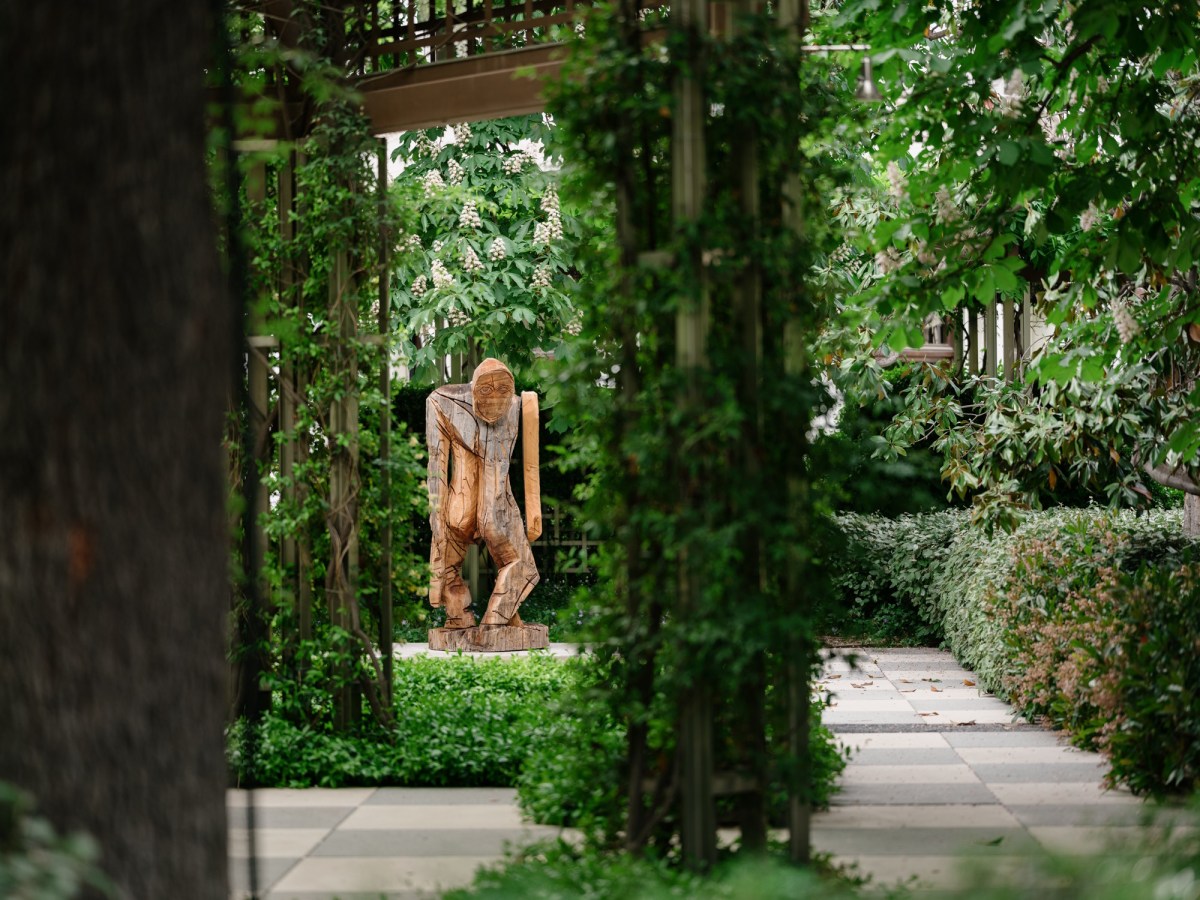
The seven works inhabiting the grounds are made from plaster, bronze and aluminium, reinforced with iron rods and hemp. Their surfaces carry the traces of their making, with seams, fractures and imprinted structures left visible in the material.
The sun catches the planes of Aluminium Construction No. 1, glinting off its surfaces until the metal seems to dissolve into the surrounding green. The newest piece featured, Janus-Mirror-Figure, appears split, its head reading as both mask and fragment. Their scale does not distance them from the viewer; instead, it brings them into a direct encounter. They are experienced not as monuments but as presences.
The garden environment amplifies the work’s inherent ambiguity. Sunlight and shadow continually redraw the surfaces of the bronze and aluminium. Falling leaves gather at the feet of the figures like offerings at temple statues, while in the pond, forms double and then break apart with the smallest movement of air.
Making the creative process visible
Curator Anne Pontégnie has described Houseago’s practice as one where ‘open structures make the creative process visible’. Here, that is enacted rather than merely described. Visitors circle the works, return to them and find that nothing stays fixed. Everything shifts with the light.
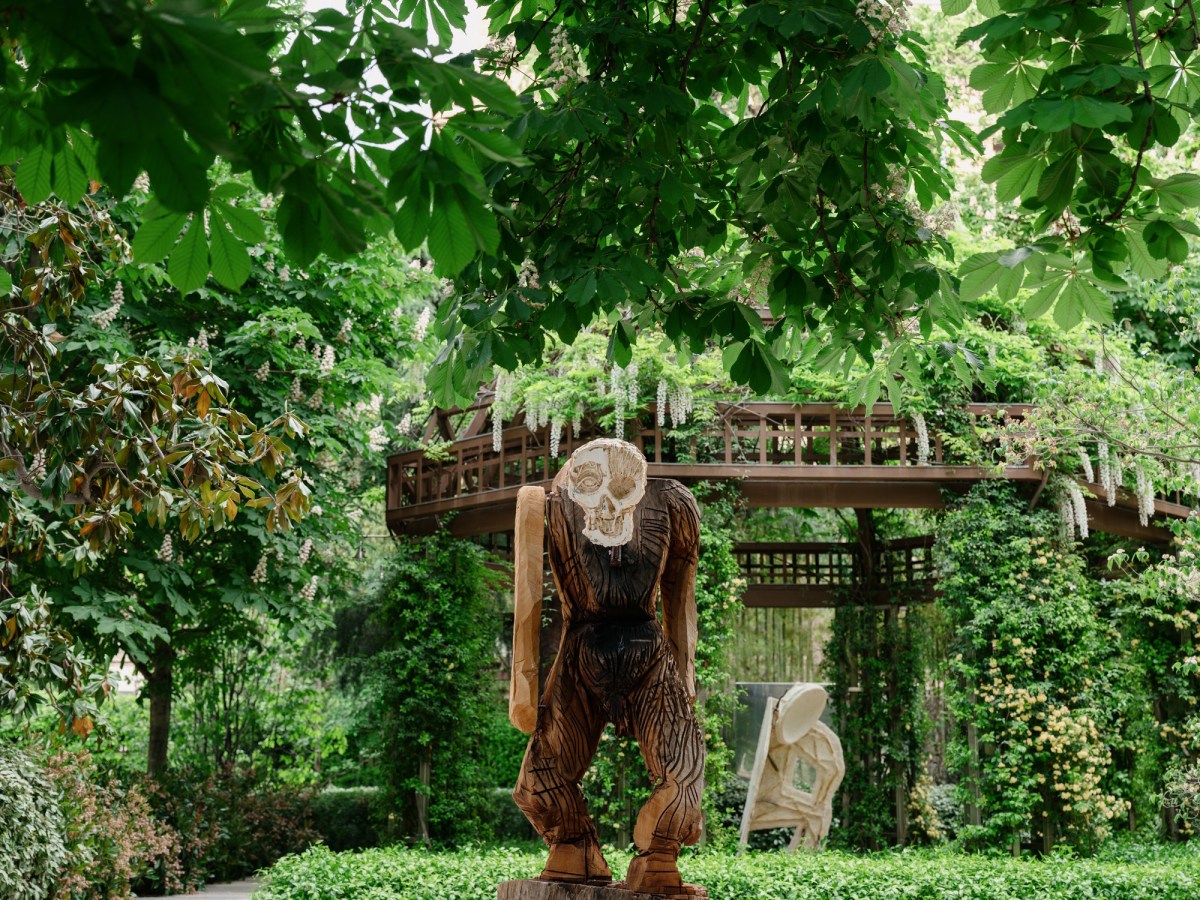
In Madrid, Houseago shared that some of the pieces ‘scare’ him, and that resonates here. The measured calm of the manicured garden serves only to intensify the friction between the setting and the sculptures – between public ease and a more private, structural unease.
This public-private battle echoes his mission to improve the accessibility of arts. ‘I think the public and the art world have become so separated in the last 50 years,’ Houseago said.
Instead of another white cube, these works now sit in a garden opened to the city for a limited season, allowing the sculptures to simply meet whoever enters – a brief, quiet subversion of the systems that usually claim them.
Thomas Houseago. Sculptures. Banca March Garden is at Banca March Garden in Madrid until 30 October 2026.
The writer travelled to Madrid as a guest of Banca March.
Discover more screen, games & arts news and reviews on ScreenHub and ArtsHub. Sign up for our free ArtsHub and ScreenHub newsletters.
[ad_2]
Source link


No Comment! Be the first one.