
As journalists in the art world, we see a lot of art. Gallery and museum shows, pop-up events, bi- and triennials, art fairs… and all of that is just for work. Because we really, truly, love what we do, anywhere and everywhere we go can turn into a pilgrimage to see more art. And we’ve been lucky enough to travel to some pretty far flung places to do so. Below, our annual roundup of the best artworks we saw this year.
Richard Serra, East-West/West-East (2014)

Richard Serra, East-West/West-East (2014). Photo: Margaret Carrigan.
I like big slabs of steel as much as the next person, but I’m not what you would call a Serra-head. Nevertheless, a sunset viewing of the late artist’s monumental “East-West/West-East” in the Qatari desert in October left me awed.
The four plates, each a towering 45 feet, are erected in a straight line spanning more than half a mile. They sit silently, totemically, in the arid Brouq nature reserve, the surrounding sand dunes offering the only relative metric for gauging their size. When I arrived, just after 3 p.m., the sun was still punishingly high and it felt like a small pilgrimage to walk from the first to the last. They really didn’t seem that big or that far apart until I got close to one. That, of course, is the point: To put things—most of all, you—in perspective.
As the temperature dipped, I scrambled to the top of a dune to take in all four at once. From higher up, the plates, each with their broad faces turned East and West, looked placidly expectant. As I scooted down a bank of sand and rock, the sun burned a dusky, dull red at the edge of the horizon, just behind the first—or last, depending on which way you walk—steel slab. Days end, a new one always dawns.
—Margaret Carrigan
Emma Ferrer, You Will Return the Evil to Its Steppe (Homage to Josefa de Óbidos) (2024)
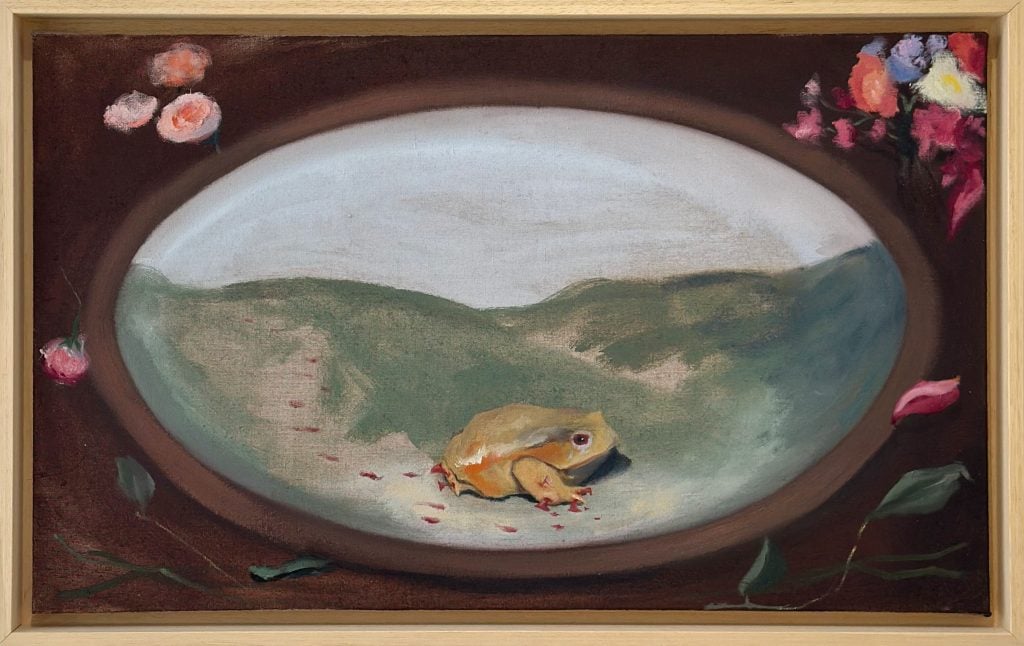
Emma Ferrer, You Will Return the Evil to its Steppe (Homage to Josefa de Óbidos) (2024). Courtesy of Sapar Contemporary and the artist.
At her painting debut at New York’s Sapar Contemporary earlier this year, Emma Ferrer presented a suite of natural landscapes, populated by lambs, dogs, and goats. The artist (the granddaughter of Hollywood legend Audrey Hepburn) had created the series while ensconced in the Italian countryside, where she has set up a studio in the Apuan Alps. There, she thought about nature and man and what man does to nature—a dynamic with primordial roots. Her paintings, however serene on the surface, are thus haunted with menace: a goat awaits sacrificial slaughter, a dog tracks bloody paw prints down a country road.
Among them was the mournful scene of a lone frog, its pierced feet leaving dots of blood on some greenery. The work nods to an ancient rite where pre-Assyrian peoples pricked a frog’s feet with rose thorns in order to heal a sickness. Ferrer’s image sees the animal returned to the wild, now heavy with humanity’s sin. I keep returning to this picture. It’s a work of aesthetic tension—its beauty woven with brutality—but also one of deep feeling, a kind of funereal portrait for a creature sacrificed and forgotten. In many ways, it gives new resonance to the term “still life.” Ferrer told me, “I don’t intend to be persuasive at all with my work.” But her silent frog, I think, speaks volumes.
—Min Chen
Kerry James Marshall, The White Queens of Africa: Colette (2025)

Kerry James Marshall, The White Queens of Africa: Colette (2025). Photo: Kate Brown.
Gallery after gallery at Kerry James Marshall’s groundbreaking retrospective, “The Histories,” at the Royal Academy of Art takes your breath away. But one room in particular floored me. “Africa Revisited” includes some of Marshall’s newest paintings, a suite that complicates and transgresses our more dominant ideas of colonialism in Africa, offering conflicting narratives that make us reflect on how ideas of race and identity are formed and upheld. What astonished me most was the way these paintings refuse the comfortable binaries through which we often read African history and postcolonial identity.
Marshall is not merely revisiting the past; he is re-composing it, forcing us to sit inside its entanglements. Two paintings struck me most: the “white queens,” both made in 2025. In both of these heavily constructed images, history comes to life through careful and considered invention and symbolism. Marshall’s ongoing project to render Blackness, literally and figuratively, within the veins of history painting and the art-historical canon is deepened by the introduction of symbolic and literal whiteness.
The first, The White Queens of Africa: Ruth, is a wedding portrait of Ruth Williams (1923–2002), a white Englishwoman who married Prince Seretse Khama (1921–1980) in 1948 and became the First Lady of Botswana from 1966 to 1980. Their union caused an uproar; the U.K. held Khama in exile in England for nearly a decade. In Marshall’s image, Williams gazes directly at the viewer while her husband is pushed out of pictorial focus. The second, The White Queens of Africa: Colette, depicts Colette Hubert (1925–2019), a French citizen who served as the First Lady of Senegal from 1960 to 1980. It is also a portrait of her wedding day, and in this highly symbolic imagery she stands in front of the Senegalese palace, a place she did not yet live in.
In these works, Marshall complicates the very idea of belonging—belonging to a place, to a history, to a narrative we think we understand. And in this sense, he does not simply paint history as part of the grand sweep of his retrospective but widens the frame.
—Kate Brown
Saya Woolfalk, Chimera (2013)

Saya Woolfalk, Chimera from “The Empathics” series, (2012) on view in “Saya Woolfalk: Empathic Universe” at the Museum of Arts and Design, New York. Photo: by Jenna Bascom, courtesy the Museum of Arts and Design, New York.
The past few years, I’ve found myself, at the year’s end, drawn back to artists whose practice is not just about the physical act of creating beautiful works of art, but is also centered around world building. In that vein, Saya Woolfalk is a stunning colorist who makes vibrant collages, mesmerizing video art, and intricate, often wearable textile sculptures. But beyond their considerable visual appeal, these works, which were this year the subject of the artist’s first retrospective, “Empathic Universe,” at New York’s Museum of Arts and Design, are the product of elaborate universes of Woolfalk’s own invention, based on a mix of mythology, feminist theory, and science fiction.
In dreaming up the Empathics, a plant-human hybrid species, Woolfalk drew on traditions and folklore from a wide variety of cultures, inspired by her own multi-ethnic background. (She also consulted with biologists!) Her mother is Japanese and her father is biracial, with both European American and African American ancestry.
Woolfalk is imagining a better world, free of racism and sexism, with a species who lives in harmony with the earth—although the Empathics do also monetize this magic in capitalist fashion, operating an “Institute of Empathy” and even a for-profit business, “ChimaTEK,” with products selling the promise of utopia. Perhaps this is a meta commentary on how artists become reliant on the sale of their work to fund their practice. But strip away Woolfalk’s invented backstory, and the work still stands on its own two feet (often literally, worn in the show by mannequins).
The gorgeous installation “Chimera” is a vibrant tableaux with seven figures in elaborate, tribal-infused garb, with richly colored robes and headdresses with petal-like forms, in front of a projected video. These repeating forms also suggest scales or feathers, and the overall effect is that of some kind of ritualistic ceremony, overseen by a high priestess. It’s a glimpse into a world you wish were real.
I tagged along for a tour of the show that Woolfalk gave to her father-in-law, who is an anthropologist, and members of his Lower Manhattan retirement community, where he functions as a kind of unofficial professor. Woolfalk’s husband, Sean T. Mitchell, is also an anthropologist, and the couple lived for years in Brazil while he researched a book and she did a Fulbright scholarship. This provides some added insight into the genesis of her scholarly approach. Woolfalk considers the societal structures and cultural practices of her speculative futures, and presents her artworks as artifacts of these civilizations in an ethnographic display.
—Sarah Cascone
Leonardo da Vinci, The Last Supper (ca. 1495–98)

A view of Leonardo da Vinci’s The Last Supper. Photo: Roberto Serra – Iguana Press/Getty Images.
When I visited Milan in September, I managed to spend a few breathless minutes nearly alone with The Last Supper. (Shout out to the team at Thaddaeus Ropac for organizing this small miracle.)
Art historians have long spoken about the “aura” of Leonardos but I had never quite felt it for myself, even after attending the Louvre’s Leonardo blockbuster in 2019. That changed the moment I stepped into the dimly lit dining hall of the former Dominican convent of Santa Maria delle Grazie. It was like the refectory’s north wall began to inhale, sucking me towards Christ’s outstretched hands.
I should probably mention that I’m not religious. But in that moment I felt all of the emotional architecture of Christianity suspended in my chest.
—Naomi Rea
Mark Fingerhut, Halcyon.exe: The Ride (2024)

Image from Mark Fingerhut, Halcyon.exe: The Ride in “Rhizome World.” Image courtesy the artist.
You know I loved this. I wrote a whole thing just about it, after I stumbled on Fingerhut’s cult opus in the show “Rhizome World.” It’s got it all for me. It feels like an artist playing around in the sandbox of the present and building something cool and new. It almost has the feeling of a piece of found digital folk art, while also feeling refined and like the product of someone who knows their craft. But I’ve said all this before. The reason it sticks around with me at the end of the year, as something to treasure from 2025, is that Fingerhut’s work feels rare in how upbeat it is. There’s a kind of vulnerability to that. The vibe is a little silly without being about brain rot, a little wistful without being depressive, mysterious without being obscure, personal without being confessional, fun without being about going numb, and all about the digital without wallowing in the horror story that digital life has become. It just feels very vital. I love it.
—Ben Davis
Suzanne Valadon, La Chambre bleue (1923)

Suzanne Valadon, La Chambre bleue (1923). Photo © Centre Pompidou, MNAM-CCI / Dist. GrandPalais – RMN
If there’s one exhibition that truly stayed with me this year, it was Suzanne Valadon’s retrospective at the Centre Pompidou in January. On a freezing winter day in Paris, I walked into what would be the museum’s final major solo show before its impending renovation, and Valadon’s first big solo show in 58 years.
The exhibition was full of freedom and unexpected joy. It allowed me to retrace the extraordinary life of a woman who once reigned as the most sought-after model in Montmartre, and who later won critical acclaim as a painter in her own right. The women in her works are never decorative. They’re relaxed, assertive, and entirely themselves.
In La Chambre bleue, I encountered a figure in total ease. She wears what looks like a modern lounge suit, a cigarette between her lips, lying across a slightly disheveled bed. Two books she’s just read are casually tossed aside. Her gaze is steady. She is no longer the object of the gaze, but the one doing the looking. That is a lovely moment captured by the artist of the woman in her own room, her own moment.
I spoke about this work during a panel in August, and said that for those of us working in the arts—be it as researchers or writers—our role is to trace the cracks in art history, and let the light in where it’s long been absent.
—Cathy Fan
Michael Heizer, City (1970–2022) and Jordan Wolfson, Little Room (2025)

A very partial view of Michael Heizer’s City (1970–2022) and an image of someone taking part in Jordan Wolfson’s Little Room (2025) at the Fondation Beyeler. Images: © Michael Heizer. Courtesy Triple Aught Foundation. Photo: Ben Black and © Jordan Wolfson. Courtesy Gagosian, Sadie Coles HQ, and David Zwirner. Photo: Mark Niedermann
I’m copping out and making two selections: the best artwork I saw for the first time this year and the best artwork I saw that was made this year. Materially speaking, these two pieces are about as different as can be, but they both result from menacing precision and a willingness to experiment on art’s edges.
First, City (1970–2022). Michael Heizer’s long-secret earthwork in a remote desert valley in Nevada is massive in every sense: ambition, scale, effect, and import. It measures a mile and a half long by half a mile wide, but it felt far larger as I spent hours wandering its winding, carefully manicured paths. (The obvious care that goes into its maintenance is moving.) Despite its monumentality, it’s a surprisingly subtle environment that reveals itself slowly, beguiling slopes and curves coming into view from atop elevations and around bends. Less a sculpture or installation than some sort of abstract philosophical game board, it is commanding, beautiful, and deeply strange. Even as it sets its gazes toward distance centuries, standing sentinel in a primordial landscape, it awaits you.
Second, Little Room (2025). Jordan Wolfson’s virtual-reality experience at the Fondation Beyeler was remarkably discomfiting, even by his standards. To partake, you stand on a platform as 96 cameras create a full-body scan that is then loaded into a V.R. program. Next, you and a partner strap on headsets and inhabit each other’s body, together in an empty room, as Wolfson intones various threatening messages. “Look at your hands, I hate you,” for instance. My hands were a darker color than normal, and impressively tattooed. They belonged to the excellent London-based artist I was paired with. Seeing myself through another’s eyes was at once unpleasant and freeing, but the awkwardness of be watched by someone whose body I had borrowed grew steadily. I was relieved when it was over.
—Andrew Russeth
Wayne Thiebaud, Cakes (1963)

Wayne Thiebaud, Cakes (1963) National Gallery of Art, Washington, D.C. © Wayne Thiebaud VAGA at ARS, NY and DACS, London 2025. Image Courtesy National Gallery of Art, Washington.
I’ve seen some good art this year, but Wayne Thiebaud’s painting Cakes (1963) is the image that stays with me. Featured in “American Still Life” at the Courtauld Gallery in London, the show that opened in October is the Modern American artist’s first U.K. museum show, and also marked my first time seeing Thiebaud’s work in person. The exhibition focused on his still lifes from the 1960s that reinvented a genre and a long lineage with a twist—that is, with objects from his time.
Among all pieces on view, I was particularly drawn to this large-scale painting. At first, I thought I was just hungry. But this marvelous painting is, in fact, food for the eyes and brain. These delicious-looking cakes in nearly life-size scale, quietly sitting on the round stands supported by a thin stem, transported me to 1960s America. The thick layers of paint that adorned the surface of the pastries like creamy frosting offered me a glimpse of an era of abundance, or perhaps the rise of consumer culture, echoing the scenes I recall from the T.V. series Mad Men, the de facto reference point for this non-American. Where were these cakes sold? Who were buying them? Could this be something that Don Draper would buy for his daughter Sally? As these imaginary narratives ran through my head, I had a newfound understanding of the power of still life paintings.
—Vivienne Chow
Walter De Maria, The Lightning Field (1977)

Walter De Maria, The Lightning Field (1977). Long-term installation, western New Mexico. ©Estate of Walter De Maria. Photo: John Cliett. Courtesy Dia Art Foundation, New York.
I wrote about The Lightning Field before I ever saw it, which may be a journalistic gaffe, but which I believe fundamentally prepared me to have a totally transformative experience when I did see Walter de Maria’s 1977 mind-boggling installation of 400 stainless steel poles in the middle of the New Mexico high desert, just this past summer.
It’s a journey that I’d hope to make for years. This year, my request happened to make the cut (reservations to visit The Lightning Field are made through Dia Art Foundation and open February 1 of each year). My husband and I, joined by Annikka Olsen (also of Artnet) and her husband, packed our bags and headed out to Quemado, New Mexico, this July, for an overnight stay in a subtly renovated homestead cabin next to the installation. We were joined by another couple, newly retired, who split their time between Idaho and Seattle.
I could come away with several short stories from my stay, but my big takeaways are that light and time are perhaps as integral to the work as anything else, as my experience shifted from overheated frustration, to comedy as I searched for one square foot of cell service where I could get updates on my kid at home, to pleasurable wonderment, to outright awe at the majesty of the land at dawn the next morning. While we didn’t see lightning (though lightning did strike the day we left), there was plenty of adventure, including a rattlesnake interlude and stories of Mexican gray wolves.
—Katie White
Max Hooper Schneider, Scavenger (2025)

Installation view of “Max Hooper Schneider: Scavenger,” at 125 Newbury. Photo by Eileen Kinsella.
I have enjoyed and admired Max Hooper Schneider’s lush, sprawling, terrarium-like built environments the many times I have encountered them, often at L.A.-based gallerist Francois Ghebaly’s art fair booths and at least one inclusion during a High Line gala event a few years back.
However the artist’s recent takeover of the 125 Newbury space in Tribeca—which Pace Gallery founder Arne Glimcher launched as a project space in 2022—was simply a knockout punch. Hooper-Schneider’s gallery-filling installation of the 75,000-square foot space is a shock to the senses in the best way possible, from the minute you step off a bright, busy downtown New York street into the dark meditative atmosphere with glowing neon lights, plants, and the sound of water trickling in fountains. It’s like stepping into another universe, filled with some signature elements—coral, teeth, crystals, and others that were new to me—mini-hooded figures with glowing neon-lit faces holding scythes, and a jarring collection of various-sized Pillsbury baker dolls tucked into a square lit-neon red by a sign that reads “Suicide.”
In addition to a deep dive Q&A with Jerome Sans, I also loved Glimcher’s story of how he connected with the artist. “Driving from Beverly Hills to Culver City, I pass Max Hooper Schneider’s studio twice before realizing that the anonymous, unmarked storefront, a vacated upholstery shop, is where this frenetic scientist/object-maker artist lives. In the shadow of the Inglewood oil fields, he thrives amid glowing uranium mushrooms, electric aquarium specimens, neighborhoods of post-apocalyptic dollhouses ad tortured ikebana,” according to Glimcher’s wall text.
—Eileen Kinsella
Other Articles

Art Demystified: The Gallery Breakdown
Art doesn’t have to shock
No Comment! Be the first one.