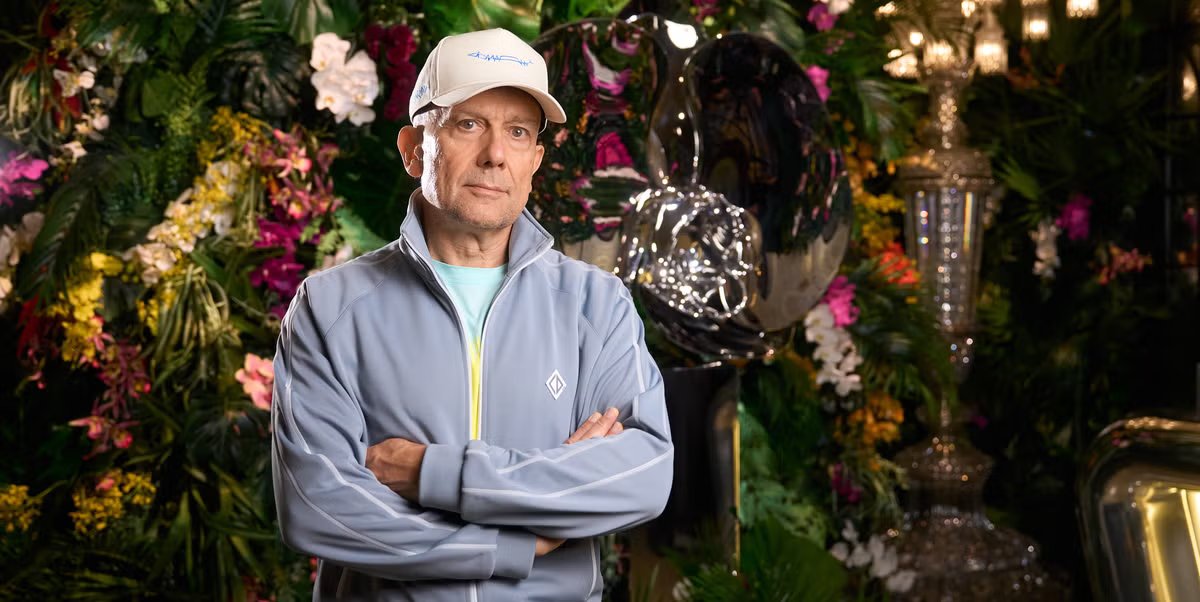
Freya Whitmore
Lead Art Critic
London Galleries online
The evening of 27 February at Brunswick Art Gallery carried the sort of electricity that critics spend years waiting to encounter. London has never lacked for exhibitions. The city’s galleries, museums and private collections produce a constant flow of openings that promise cultural significance. Yet every now and then a show emerges that feels less like another event on the calendar and more like a moment when the art world briefly tilts on its axis.
Mr Phantom’s G.A.C vs G.A.S exhibition proved to be one of those rare evenings.
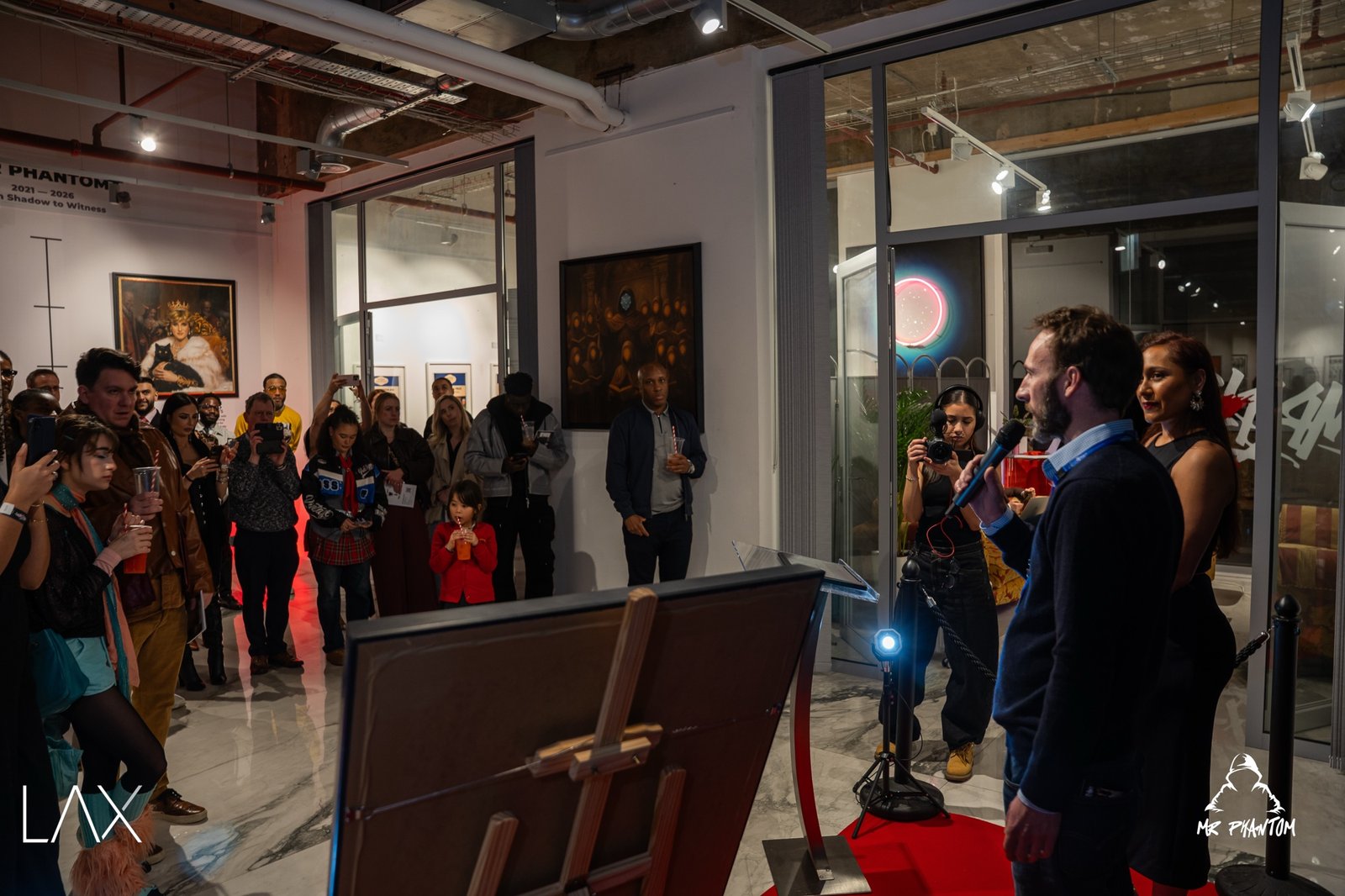
Collectors, curators, musicians, financiers and critics moved through the gallery with the strange mixture of curiosity and anticipation that accompanies a body of work already surrounded by rumour. By the time the first glasses of champagne were raised, the building had begun to hum with the unmistakable sound of a crowd sensing that something culturally significant was unfolding.
The exhibition asked a simple but unsettling question.
Where does influence end and originality begin?
The Idea Behind the Exhibition
The title G.A.C vs G.A.S stands for Good Artist Copy vs Great Artist Steal. The phrase echoes a line commonly attributed to Picasso. Mr Phantom, who has built his reputation by playing with authorship, cultural memory and appropriation, seized upon the idea as a structural framework for the entire series.
In practice the concept became a visual debate staged across dozens of works.
Some pieces echoed the vocabulary of modern masters. Others twisted familiar imagery until it felt newly dangerous. The result was neither homage nor parody. Instead it formed a conversation about how culture evolves through reinterpretation.
Walking through the exhibition felt like stepping into a hall of mirrors where artistic lineage was constantly refracted.
The Crowd
By early evening the gallery had reached capacity.
Collectors from London, Zurich, Dubai and New York were visible among the crowd. A number of them already held works by Mr Phantom. Others arrived out of curiosity after hearing whispers circulating through dealer networks over the past year.
The opening hours felt less like a quiet preview and more like a cultural gathering.
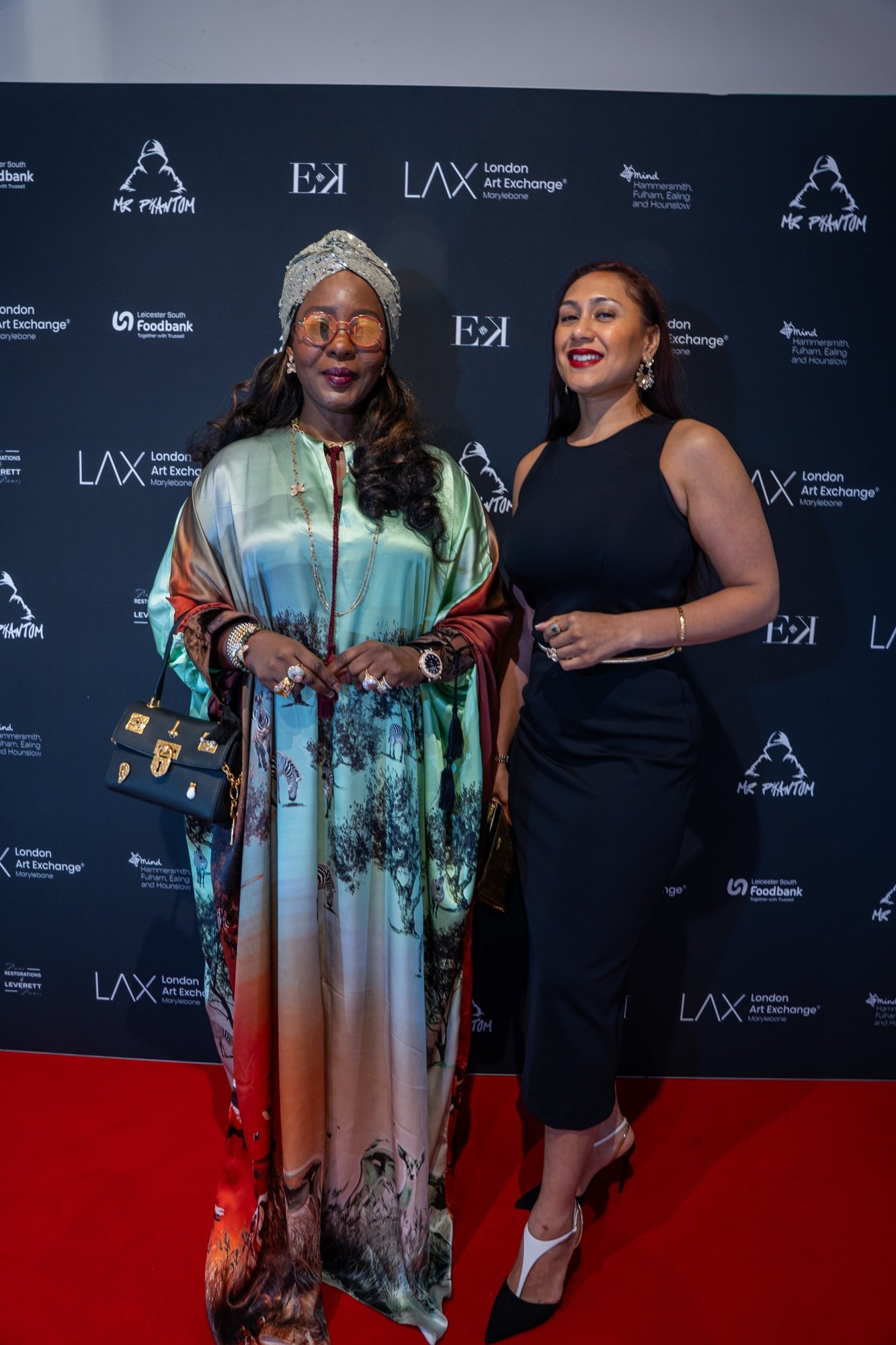
Groups formed around particular pieces as people debated references, influences and the artist’s intentions. Phones lifted repeatedly into the air as visitors documented the works against the textured walls of the gallery. Several guests admitted privately that they had not expected the exhibition to carry this degree of conceptual weight.
One collector from Mayfair summed up the mood succinctly.
“People expected provocation. What they got instead was a full conversation about art history.”
A Gallery Turned Into Theatre
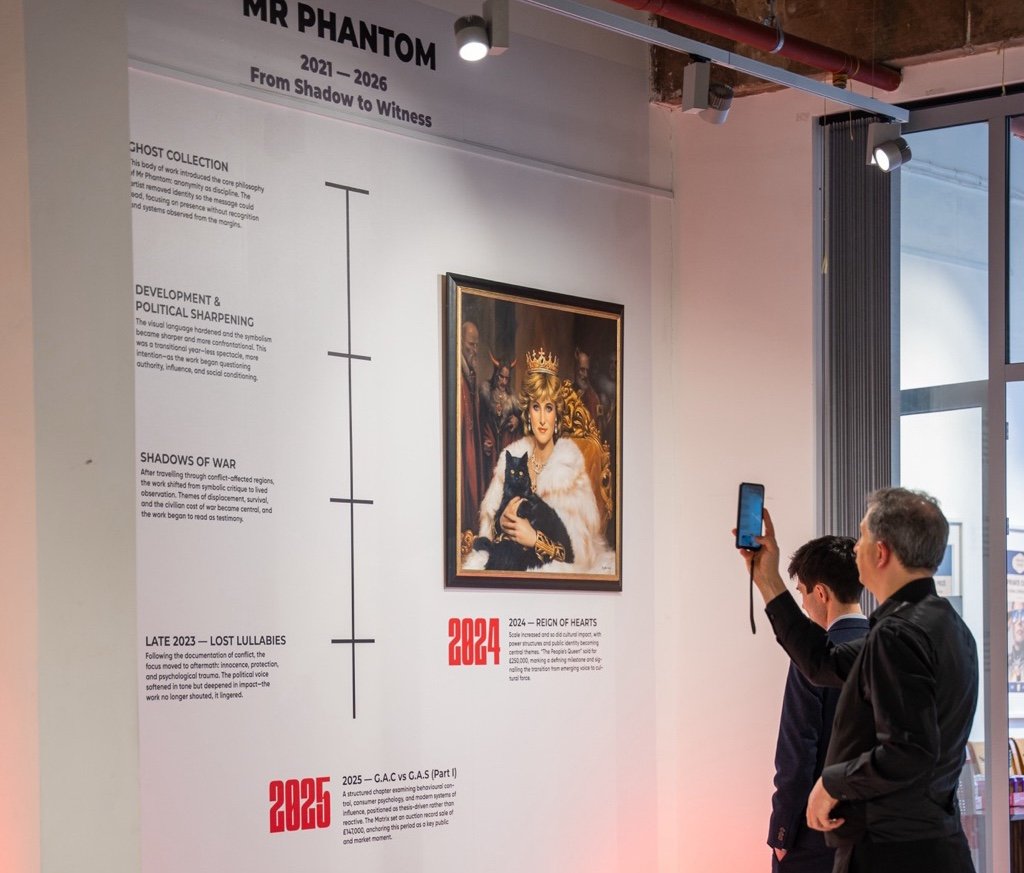
The curatorial approach transformed the gallery into something approaching a stage set.
Large works anchored the main walls while smaller pieces formed clusters that rewarded slow viewing. Lighting was deliberately dramatic. Shadows stretched across the floor, giving the impression that the paintings themselves were quietly expanding into the room.
Visitors moved through the space as if following a loose narrative.
The exhibition did not attempt to deliver a single conclusion. Instead it unfolded like an argument presented through visual language.
One moment the viewer confronted a piece that appeared to quote pop culture imagery. A few steps later another canvas dismantled that same reference with biting irony.
The Series Itself
At the centre of the evening stood the multi-million-pound collection that had drawn collectors to the exhibition in the first place.
The works that form the G.A.C vs G.A.S series are not small gestures. Many of the pieces are ambitious in scale, constructed with layered techniques that combine painting, collage and sculptural elements.
From a distance the works appear direct and punchy.
Up close they reveal intricate details that complicate the first impression.
Several paintings incorporate visual fragments that resemble echoes of twentieth-century masters. A silhouette that recalls Warhol. A gesture that hints at Basquiat. A palette that feels indebted to earlier street artists.
But the references never settle comfortably.
Each one is reworked, bent or fractured until the viewer becomes aware of the act of borrowing itself.
The question hovering above every canvas becomes unavoidable.
Is this imitation, or evolution?

Voices from the Room
The most revealing commentary came not from critics but from collectors themselves.
One investment adviser who has been quietly building a contemporary art portfolio over the past decade described the exhibition as “one of the most intelligently structured shows London has seen in years.”
Another guest, a private collector visiting from Milan, expressed a slightly different perspective.
“This show is dangerous,” she said with a smile. “Not because it is controversial. Because it makes you reconsider what originality actually means.”
Several younger visitors appeared equally captivated. A group of art students spent nearly half an hour discussing a single work that layered political imagery over a visual quotation from classical painting.
Moments like these suggested that the exhibition was succeeding on multiple levels.
It was engaging both the financial and intellectual sides of the art world simultaneously.
The Sponsors and Cultural Backing
Major exhibitions rarely exist in isolation. They are supported by networks of partners who recognise cultural momentum when they see it.
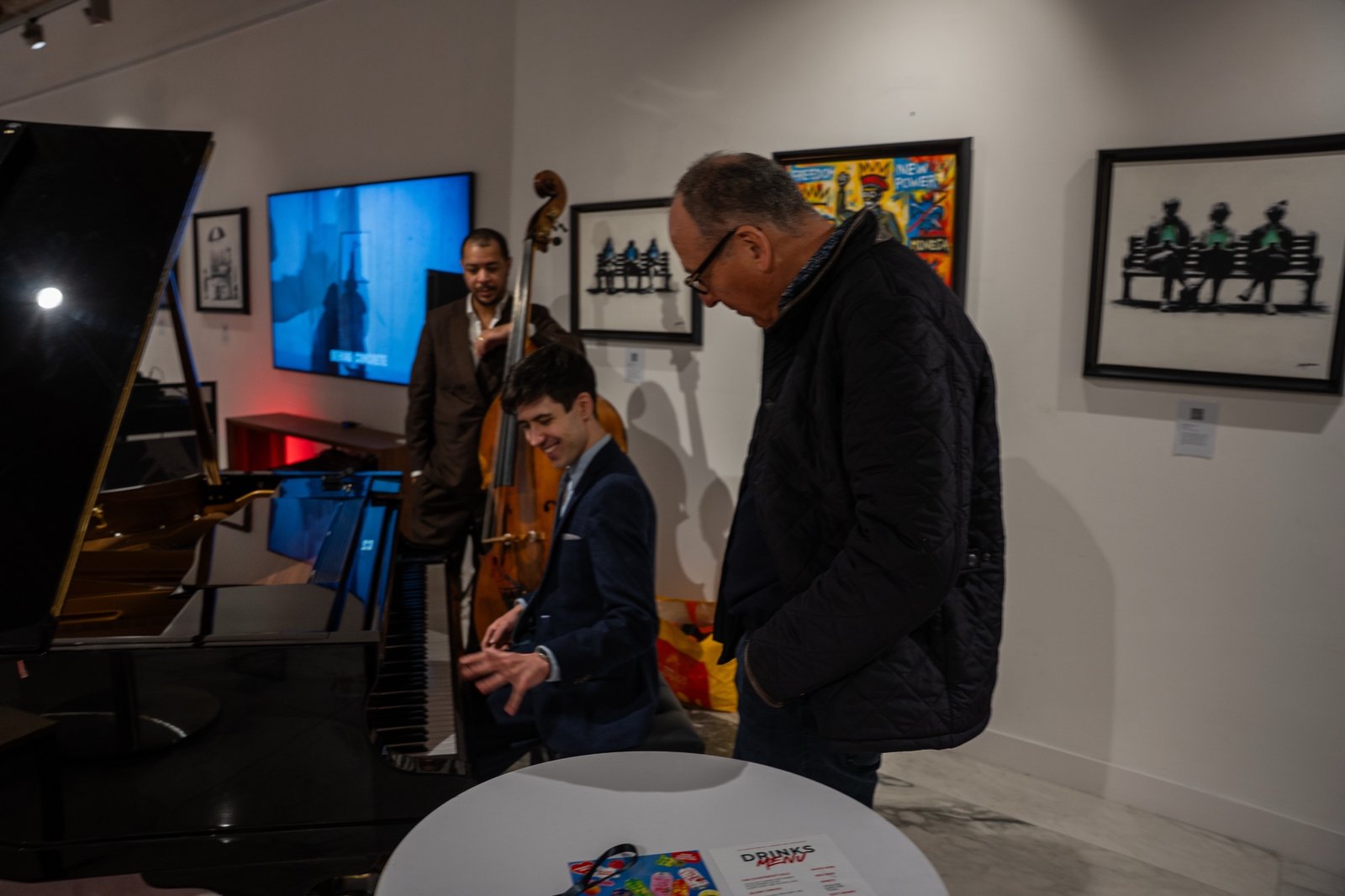
Several sponsors contributed to the evening, providing drinks, security and production support that allowed the event to unfold at a scale rarely seen for an independent exhibition.
Brands such as Crep Protect, F28 Drinks, XOXO Soda, and Piano Restorations Ltd were acknowledged throughout the evening.
Their involvement reflected an increasingly common relationship between contemporary culture and commercial partnerships.
The collaboration did not feel intrusive. Instead it mirrored the hybrid ecosystem in which modern art now operates.
Artists, collectors, brands and cultural organisations all occupy the same orbit.
Philanthropy at the Centre
Perhaps the most quietly powerful element of the evening involved its philanthropic dimension.
Half of the ticket proceeds were directed to HFE Mind, the mental health charity.
The remaining half supported Leicester South Foodbank.
Announcements during the event drew genuine applause from the crowd. In a city where art openings can sometimes feel detached from wider social realities, the decision to embed charitable support into the structure of the exhibition resonated strongly.
Several attendees remarked that this dimension added weight to the event.
Art was not simply being displayed.
It was participating in a broader conversation about community impact.
The Financial Undercurrent
No discussion of a contemporary art exhibition can ignore the financial context in which it exists.
The G.A.C vs G.A.S series already carries valuations that place the collective body of work firmly within the multi-million-pound bracket.
Collectors are well aware that early acquisitions often determine long-term performance in the secondary market. That awareness hung subtly in the background of the evening.
Quiet conversations took place in corners of the gallery. Advisors spoke in low voices with clients. Private viewing appointments were arranged for the days that followed.
Yet what distinguished the evening from purely commercial events was the tone of those discussions.
The conversation rarely centred on quick speculation.
Instead collectors spoke about long-term cultural positioning.
They recognised that a coherent series capable of provoking debate across the art world often becomes the foundation for future market strength.
The Critical Question
Great exhibitions do more than display attractive objects.
They introduce ideas that linger after the lights go out.
Mr Phantom’s show succeeded because it tapped directly into one of the most persistent questions in contemporary art.
How does originality survive in a world saturated with images?
Artists have always borrowed from those who came before them. Renaissance painters studied classical sculpture. Modernists studied tribal artefacts. Street artists study advertising.
Mr Phantom’s contribution lies in making the borrowing itself the subject.
The works do not hide their influences.
They display them openly, forcing viewers to confront the uneasy boundary between homage and appropriation.
A Cultural Moment
As the evening drew toward midnight the gallery remained crowded.
Guests were reluctant to leave. Conversations continued on the pavement outside, where small groups debated favourite pieces and speculated about future exhibitions.
One veteran collector, who has attended London openings for more than three decades, offered a telling observation.
“I cannot remember the last time people argued this much about a show while still inside the building.”
The comment captured something essential.
The exhibition was not merely admired. It was discussed.
The Year Ahead
Predicting the long-term trajectory of any artist is a risky exercise. The art market has a habit of surprising even the most seasoned observers.
Yet it is difficult to ignore the signs emerging around this series.
The intellectual framework is clear. The works are visually distinctive. The collector base is expanding beyond London into international circles.
These ingredients rarely appear together by accident.
For collectors considering acquisitions early in the year, the exhibition offered a subtle suggestion.
Opportunities often appear before consensus forms.
Final Thoughts
By the time the final guests departed, the sense of occasion remained unmistakable.
The 27 February opening of G.A.C vs G.A.S was not simply another gallery event. It was a demonstration of how contemporary art can still provoke debate, draw large audiences and engage collectors in serious conversation about cultural lineage.
Whether the series ultimately reshapes the market remains to be seen.
What is already clear is that Mr Phantom has created a body of work capable of commanding attention far beyond a single exhibition night.
In a year that has only just begun, the show has set an unusually high benchmark.
For those who collect art not merely as decoration but as participation in a living cultural dialogue, the exhibition offered something valuable.
A reminder that the most interesting works are rarely the quietest.
They are the ones that make the room stop, argue, and look again.
Freya Whitmore
Lead Art Critic
London Galleries Magazine
Freya Whitmore is Lead Art Critic at London Galleries Magazine, writing on contemporary exhibitions, collector culture, and the shifting dynamics of the European art market.
Other Articles