
[ad_1]
Major cultural institutions in New York and Montreal are expanding their permanent collections with Indigenous installations that challenge traditional narratives surrounding George Washington and early North American history. The newly displayed artifacts coincide with the 250th anniversary of the Declaration of Independence and the American Revolution.
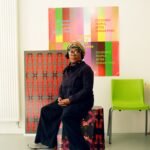
The Metropolitan Museum of Art in New York City is showcasing an installation by Kahnawa’kehró:non artist Carla Hemlock titled “The Homelands.” The textile piece features a handmade wool blanket decorated with Haudenosaunee designs and a map of destroyed villages, positioned directly facing a historical portrait of Washington.
The artwork highlights explicit military orders issued by Washington during the 1779 Sullivan Campaign. A specific quote outlining instructions for the total destruction of Indigenous settlements is sewn onto a yellow patch on the textile piece.
“The immediate objectives are the total destruction and devastation of their settlements and the capture of as many prisoners of every age and sex as possible. It will be essential to ruin their crops now in the ground and prevent their planting more.” stated George Washington, General of the Continental Army.
Hemlock submitted the artwork to the Met in 2024 after being approached by museum curators, and the piece has since been acquired as a permanent part of the museum collection.
“Those orders were to destroy all the Haudenosaunee villages and to just annihilate our homelands and our people,” said Carla Hemlock, Artist.
The installation aims to provide visitors with an unvarnished look at the foundational history of the United States.
“By them placing it facing George Washington, that’s huge. That’s a huge impact for anybody who’s going to see it,” said Carla Hemlock, Artist.
The artist admitted that having her work selected by such a major institution was completely unexpected.
“I’m still trying to process it, where it is and the impact that it’s making,” said Carla Hemlock, Artist.
Hemlock has established a long career making clothing, blankets, and quilts, turning to US art shows in her 40s before the COVID-19 pandemic interrupted her circuit routine.
“It was never in my thoughts to say my work would end up at the Met,” said Carla Hemlock, Artist.
The exhibition represents a significant milestone for the Kahnawake weaver, who anticipated an emotional reaction upon viewing the display in person.
“It’s just not something that you dream of. It was too big. For me, it was too big. So I never even went there in my thoughts.” said Carla Hemlock, Artist.
Hemlock noted that the pandemic pause unexpectedly allowed her to establish her own production timeline while drawing increased interest from various institutional curators.
“It’s a constant wheel where you can’t get off if it,” said Carla Hemlock, Artist.
Another installation by Hemlock and her son, filmmaker Raohserahawi Hemlock, titled “In the Arms of the Natural World,” was recently donated to the Montreal Museum of Fine Arts (MMFA) for its permanent collection. The multimedia project consists of three quilts and two films focusing on the legacy of residential schools.
“Because it’s such a difficult, difficult subject to approach, we both approached it with absolute delicacy and care,” said Carla Hemlock, Artist.
The artist emphasized that creative expressions provide vital commentary during turbulent political climates.
“It’s a crazy time right now, all over the place. People can’t really express freely, especially in the United States.” said Carla Hemlock, Artist.
The artist maintained that creative mediums serve as a powerful tool for self-expression and community elevation.
“The arts give you that freedom to express an idea or to lift people. I’ve accomplishments always thought the arts are just an incredible vehicle for people to express themselves.” said Carla Hemlock, Artist.
“The arts are just really needed,” said Carla Hemlock, Artist.
Her son and collaborator noted the development of her creative output over time, which has drawn considerable engagement from institutional visitors.
“She’s been upping her game constantly,” said Raohserahawi Hemlock, Filmmaker.
The young filmmaker expressed mutual admiration for his mother’s evolving artistic style and its capacity to engage museum audiences.
“The place where she currently landed on was these beautiful quilts that are painstakingly made, but they’re not just there anymore just to be pretty. It wasn’t always just that, but it’s kind of like you as a viewer are a bit more challenged by looking at the art now.” said Raohserahawi Hemlock, Filmmaker.
MMFA curator of Indigenous practices Léuli Eshrāghi described the acquisition as a powerful addition to the gallery collection that required a full year of preparation.
“This is a huge work,” said Léuli Eshrāghi, Curator of Indigenous Practices at the MMFA.
Eshrāghi has focused on expanding the representation of Indigenous creators since joining the Montreal museum three years ago.
“It’s really powerful and took so much time for them to make.” said Léuli Eshrāghi, Curator of Indigenous Practices at the MMFA.
The curator noted that the institutional collection previously featured only one Kanien’keha:ka artist.
“When I arrived, there was only one Kanien’keha:ka artist in the collection and I was super shocked,” said Léuli Eshrāghi, Curator of Indigenous Practices at the MMFA.
The inclusion of the collaborative installation brings the total number of Kanien’keha:ka artists represented in the collection to seven. The “Rising Suns” exhibition is scheduled to remain open at the MMFA until October 11, offering free admission to Onkwehón:we visitors.
Simultaneously, Harvard University’s Peabody Museum of Archaeology and Ethnology announced it will display George Washington’s historic blue silk sash from May 25 through October 18, 2026. Washington purchased the taffeta ribbon on July 10, 1775, for three-quarters of a pound sterling to distinguish himself from Continental Army troops.
“When he first wore it is unknown,” said Horace D. Ballard, Curator of American Art at the Harvard Art Museums.
Historical records indicate Washington stopped wearing the accessory by 1780, as noted by military observers at the time.
“has given up that unrepublican distinction.” stated a French soldier in a historical letter.
The artifact was preserved by artist Charles Willson Peale before passing through the Boston Museum and eventually arriving at Harvard in 1899.
[ad_2]
Source link
No Comment! Be the first one.